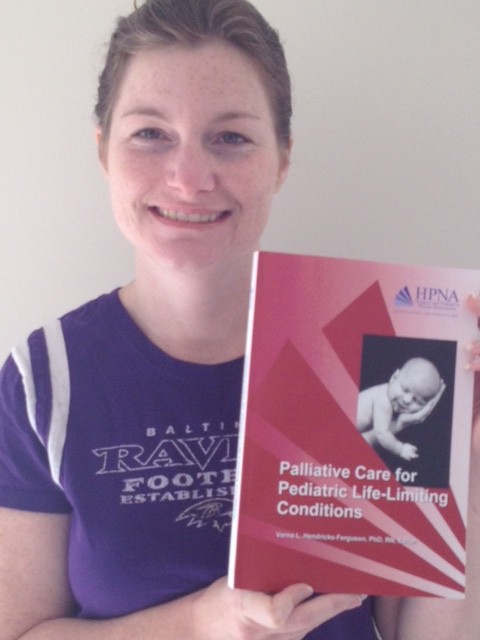
Brenda Blunt is a current Capella University student enrolled in the Doctor of Health Administration (DHA) program. She also happens to be the author of a chapter in the newly published textbook Palliative Care for Pediatric Life-Limiting Conditions. Blunt recently talked with Capella about her education and work experience and how they contributed to her being published.
Q. What led you to the DHA program at Capella?
A. My first degree was an associate’s in education, followed by a bachelor’s in biology, which led to work in public health for the state of Maryland. I moved to the neonatal intensive care unit (NICU) at The Johns Hopkins Hospital after earning my bachelor’s in nursing, followed by a master’s in leadership and management. I’ve also worked with the Centers for Medicaid and Medicare.
I found that working in palliative care and hospice was my passion, especially on the pediatrics hospice team. I realized I wanted to go into policy. I want to work on how we implement the new health care coverage on a national level and affect change in that area. That’s what brought me to the DHA program at Capella.
Q. What is your coursework like?
A. Right now I’m in an advocacy course in which we have to pick something that needs change and develop theories about how that could happen. I’m interested in concurrent care (when two or more physicians care for a patient at the same time, often working on the same condition) and what it would take to change national policy on how concurrent care is offered and managed.
Q. How have your studies contributed to your being published?
A. I’m very passionate about palliative and hospice care. It’s difficult, but so rewarding. I’d love to see concurrent care move forward. Too often the medical arena focuses strictly on the medical condition and trying to cure it, but when specialists work with hospice and palliative care providers, the emphasis changes and becomes more patient-centered, and it also allows the patient’s family and loved ones to be part of the treatment. When the opportunity to write this chapter arose, it was a perfect blend of my passion and my current studies.
Q. What do you plan to do with your degree?
A. I really want to craft my career to become an advocate for health care. I have two major goals: to learn what goes into health care financing and to learn how we discover the pieces that need change or improvement and act on those.
For example, we need to continue learning about different cultures and how to work with them within health care. Some cultures are patriarchal—how do we operate within these cultures? The provider may expect to deal with a child’s mom, but the father is the one who handles all the conversation. We also need to look at how we handle moral distress for providers, when their own culture has a different set of values than their patient, such as when a patient’s beliefs don’t allow things like blood transfusions. These are areas that need improvement for providers.
Q. Why Capella?
A. I wanted a doctorate, but I knew an in-person program wouldn’t be a good fit. I did a lot of research, looked at many different programs, different career paths people have taken, talked to senior executives in government regarding their career choices, and looked hard at class choices in different programs. I liked Capella’s structure, and I could choose a career with classes that would get me where I wanted to go, without having to leave my family one weekend every month.
Q. What do you like most about Capella?
A. I really like the interactions with instructors. They’re very personable, easy to reach, and they have great respect for the experience and expertise students bring to the table. I also love the diversity of my classmates. There are people from all different health care professions and all different backgrounds. The lessons aren’t just from textbooks, but from the partnership with other students.